Pages

Sunday, April 24, 2011

The Science in Losing Weight

Nowadays, many people are countering weight gain by eating less. However, weight loss from diets does not mean permanent weight loss. In fact, people who have undergone diets usually find that their weight springs back up right after the diet.

So why is this so?

First of all, fat is just a means for your body to store energy from the food you eat. When you eat less, you are slowing down your metabolism (rate your body uses up energy from your food), because frankly, you would be less active being hungry all day. The only positive thing is, with less food in your system, less fat will accumulate in the body. However, once the diet's over and your intake of food becomes normal again, fat will build up in your body a lot faster than before as you cannot metabolise fat as fast.

So, the way I recommend you to counter weight gain is to become more active and exercise more often. Not only will it burn up the energy reserves (fat) in your body, it will also make you stronger and give you a bit more confidence. Most importantly, fat will accumulate slower in your body as you will have a higher metabolism.

Some other great tips:
  • Chew More, Eat Less
  • Stand Up Straight

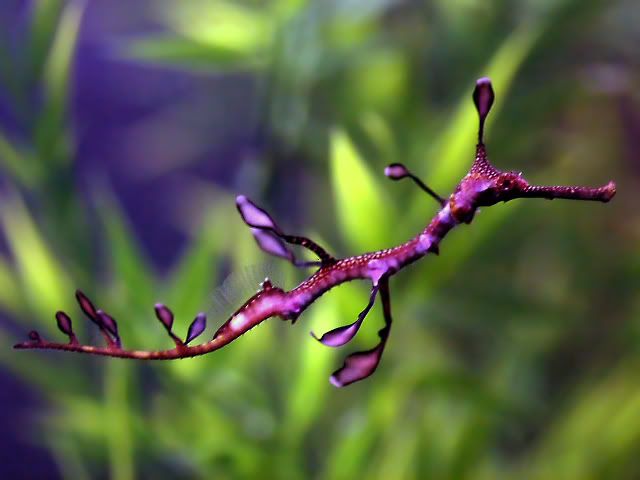
Leafy and Weedy Seadragons

Weedy Seadragon

There are many amazing animals out there with astonishing camouflage capabilities. The stick insect and the mimic octopus are great examples. Two animals that caught my attention are the Leafy and Weedy Seadragons.

The Leafy and Weedy Seadragons are found in reefs off the coasts Australia and are closely related to seahorses. They are elusive animals that feed on tiny crustaceans, zooplankton, and sometimes small fish and shrimp. The Leafy Seadragon can grow up to 24 cm while the larger Weedy Seadragon can grow up to 45 cm.

Leafy Seadragon

Perhaps what's most amazing about these creatures is their outwardly appearance, especially the Leafy Seadragon. With its many leaf-like outcroppings on its body, and its floating-like way of swimming, the Leafy Seadragon greatly resembles a floating piece of seaweed. Mixed in with a bunch of real seaweed, the Leafy Seadragon is almost indiscernible.

Like seahorses and pipefish, male seadragons nurture and protect the eggs until they hatch. Infant seadragons are completely independent afterwards. It is estimated that only about 5% of the infants survive.

3D without Glasses - How the Nintendo 3DS works


Nintendo's new 3DS is quite an impressive device. Unlike any of the other handheld gaming devices out on the market, the 3DS allows users to play games in 3D, without the glasses!

Nowadays, we know that to watch 3D, we have to wear those bulky glasses that sag over the face. However, the innovative 3DS uses a completely different technology to let the images burst out of the screen. The device uses what's called a parallax barrier LCD screen developed by Sharp. This technology has been around for a few years before but have never really been commercialised as the 3D effect is lost even at minutely differently viewing angles. However, on a small screen such as the DS where usually only one person is looking at the screen at a time, it does not pose a huge problem.

The 3D effect is achieved by the brain meshing up two different images sent to the left and right eye. Because the 3D glasses have different lenses for the left and right eyes, the 3D effect is achieved. What a 3D display does is that it uses an overlay over the LCD display that sends the different images to the different eyes. Thus, the screen acts as the 3D glasses.

Sharp's parallax display is basically a 3D display that can be turned off to display 2D images. For the more technical among us, here's a picture explaining further how the display works.

Goby helps Blind Shrimp


The shrimp goby and the pistol shrimp share a very special relationship. Biologists call it a symbiotic relationship where different species help each other to survive. In the case of the shrimp and the goby, it is an amazing one.

The pistol shrimp are very apt at creating and maintaining burrows in poor sand conditions where parts of the burrows often collapse. This provides a safe haven for the shrimp goby. In return, the goby acts as an early warning system for the almost blind pistol shrimp. This is achieved by a constant physical contact between the shrimp and the goby. The shrimp will always try to keep an antennae on the goby to receive signals from the goby if there is a threat. The goby also signals the shrimp when it's safe to go outside.

One puzzling aspect of the relationship is how the shrimp and goby choose their partners. There are much speculations and the best possible explanation right now is that the shrimp uses its more developed chemical senses while the goby uses its sight to seek out a partner when they are young.

Sunday, April 17, 2011

Cabbage, Broccoli, and Brussels Sprouts the Same Species?

Brassica Plant

Did you know that cabbage, broccoli, cauliflower, and Brussels sprouts are the same species? They are derived from the Brassica plant that farmers in the past have grown for food. Broccoli and cauliflower was the result of breeding Brassica plants with thick clusters of flowers. Cabbage and Brussels sprouts are the result of breeding Brassica plants with thick clusters of leaves. The roots are also believed to be the ancestor of the modern tulip.


Don't believe me? A definition for what makes a species is that they cannot interbreed. However, as an example, broccoli and cauliflower can breed, resulting in broccoflower.

These plants are all examples of the result of artificial selection where farmers select for favourable traits in a population of organisms and the resulting population will eventually have more and more of that trait. This can also be seen in dogs and horses.


Another great example is the modern corn. Its ancestor is a wild plant called the teosinte that have only about ten or twenty kernels on one cob.