Pages

Friday, June 22, 2012

BEEHIVE IN YOUR HOUSE - fresh honey everyday

The electronics company Phillips designed a concept for an urban beehive. This artificial beehive provides access to fresh honey in the comfort of your home as well as a glimpse into the ever-busy world of a bee. This concept consists of two parts. The first is the outer visage that connects the hive to the outside world. There is a small tube that allows bees to leave the beehive, as well as a flower pot underneath (more for aesthetic purposes) where the bees can use for pollination.

The second part of the concept is where it is most intriguing and ingenious. It consists of an orange upside down tear shaped glass dome that houses an array of honeycomb frames. This frames have a honeycomb texture that allows bees to build their wax cells on. The glass is orange to help the sight of the honey bees, as orange is the wavelength bees use to see. The honey from the bees can be accessed through a small faucet underneath the glass dome. In case there is a need to access the inside of the bee hive, smoke can be released into the hive to calm the bees down.

Besides giving the average household a constant supply of fresh honey and providing a view into the everyday lives of bees, the urban beehive concept has real, positive, environmental impacts. Bees pollinate plants, thus helping the surrounding plant life. Also, since global bee populations are on a decline, the urban beehive will help bolster the population.

PROJECT FIONA - ultra high performance gaming tablet


In recent years we have seen the tablet market boom with the release of the Apple iPad. Many tech companies all want a share of this new unprecedented market and have created their own makes of tablets. These oversized smart phones are all aesthetically appealing with slim cases and large screens. However, aesthetic appeal aside, no one expects that any of these tablets will be used by hardcore gamers to play the latest video game titles such as Skyrim and Modern Warfare 3. Casual games such as Angry Birds and Farmville are more often associated with tablets.

Even though it is generally accepted that tablets do not have a high processing power, Apple has constantly been pushing the limits. Each new generation of the iPad is a lot more powerful than the previous and currently, the iPad 3 runs on a dual core processor. Microsoft's newest tablet product, the Surface, uses a quad core processor. The PRO version of the Surface has an i5 and can run Diablo 3.

However, the iPad 3 and Surface are all designed for purposes besides gaming. So what is the result of a company that is designing a tablet specifically for hardcore gaming? Razor's PROJECT FIONA is the end product. 

Although so far the details are scarce, here is an overview of what FIONA has to offer (http://www.fudzilla.com/notebooks/item/25518-razer-details-its-project-fiona-at-ces):
  • 10.1-inch 1280 x 800 pixel screen
  • i7 Ivy Bridge CPU
  • Multi-touch supported 
  • 3-axis gyro
  • magnetometer
  • accelerometer
  • Dolby 7.1 surround sound
  • force feedback
  • Bluetooth 3.0
  • WiFi 802.11bgn 
FIONA will also use Windows 8 as its OS, which means that a multitude of the latest hardcore games will be available on it. 

One of tablet-gaming's greatest setbacks is that the touch screen interface isn't efficient for game genres such as an FPS. The virtual joy sticks on the screen are not perfect and using them can be quite annoying. FIONA meets this problem with two attached nun-chuk like controllers on the sides with joy-sticks and several buttons. The nun-chuks do not sacrifice a whole lot in terms of portability and makes gaming on the FIONA a lot more fun and easy. 

The price-tag of the FIONA is rumoured to be up to $ 1000 and it is slated to come out sometime in the Fall/Winter of 2012.


WHAT YOU SHOULD KNOW: At CES 2012, Razor showed off its FIONA prototype running SKYRIM on ULTRAHIGH settings with minimal lag. Now THAT is impressive.

Thursday, June 21, 2012

ORBIT LEVITATES LAUNDRY - and cleans without water

The "Orbit" is a concept washing machine designed by Elie Ahovi for the Electrolux Design Lab. The machine levitates your laundry and cleans it with dry ice. No water is used.

In detail, the process first begins with the user loading their clothes into a metallic sphere that is double-coated with shatter-proof glass. The spherical ball is opened and controlled with a ceramic touch screen interface. To levitate the ball, it must first be supercooled using liquid nitrogen. This causes its electrical resistivity to drop and the ball becomes a superconductor. In this state, the ball can levitate as a battery-filled ring surrounding the ball generates a magnetic field.

The washing process consists of dry ice being blasted at the laundry at high speeds. The CO2 sublimates on contact with the clothing, causing no damage. Instead, it interacts and breaks down the unwanted organic material in the laundry. The dirt and waste from this process is filtered through a tube that you can clean. To re obtain dry ice, the CO2 is frozen again.

The cleaning process is fast and noiseless but the "Orbit" incorporates several far-fetched technologies not readily available to the masses. However, it would be quite interesting to have a future where this washing machine concept is a common commodity in the future household.

Wednesday, June 20, 2012

MICROSOFT SURFACE vs. APPLE IPAD 3


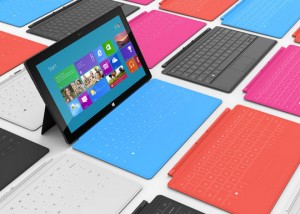
Microsoft recently gave the public a sneak peak to its new tablet, the Surface. On first look, the Surface is sleek and stylish. It has a built-in kick-stand and a snap-on keyboard (allowing it to be a laptop as well). Surface will also come with the new Windows 8 operating system. Initial public opinion of the Surface is very favourable and it has been touted as the next consumer favourite.

Microsoft is planning to release two different versions of the Surface, the Surface RT and the Surface PRO. The Surface RT is a slightly stripped down version of the PRO, aimed for casual tablet users. It uses a NVIDIA Tegra 3 Quad Core processor and comes with a 10.6 inch display. Onboard memory options include 32 GB and 64 GB. The Surface PRO runs on a much stronger Intel Ivy Bridge Core i5 Processor. It has the same sized display. Onboard memory options include 64 GB and 128 GB. The Surface PRO is strong enough to run top notch 3D games such as the recently released Diablo 3.

However, as much as everyone is raving about the new tablet, the real question is: How does the Surface compare to other heavyweights on the market, and especially the IPAD 3?


CASING/DURABILITY

Apple has long been praised for its quality hardware and this is no different for its iPad line. Microsoft understood this and in publicizing for its new tablet, has greatly lauded the "VaporMG" finish on the Surface's casing. The company claims that this finish will not only give the Surface more aesthetic and textile appeal, but also increased durability and better grip. So what exactly is the "VaporMG" finish? According to Microsoft, this casing is made of moulded magnesium and various other metals. The use of magnesium allows it to be extremely thin (down to 0.6 mm in some areas) while still being light and strong.

Not only does the Surface have a quality case, but the screen is also made of Gorilla Glass. Gorilla Glass has a renowned industrial reputation for being thin yet VERY damage resistant. For Apple's iPad, it is unknown whether Gorilla Glass is used in the screen (as seen from this article: http://home.howstuffworks.com/gorilla-glass-used-in-an-ipad1.htm).

OPERATING SYSTEM


Apple has constantly been criticized for not releasing the OS X on the IPad. The iOS was originally designed for smaller mobile devices like the iPhone and iPod Touch and this limited capability of the iOS is unfavourable to more serious tablet users. The Surface Pro will offer Windows 8 Pro, which has the full OS experience.


SCREEN SIZE AND DISPLAY

Both versions of the Surface (all 10.6 inch) have a larger screen size than the iPad's 9.7 inch.

The iPad's screen resolution, however, outshines both versions of the Surface tablet. Surface RT has a 720p resolution while Surface PRO has a 1080p resolution. The iPad 3's pixel coverage is 2048x1536.

THICKNESS AND WEIGHT

The iPad 3 has about the same thickness as Surface RT (as 0.37 inches thick) while the Surface PRO is 0.53 inches thick.

The Surface RT weighs 1.5 pounds while the PRO weighs 1.9 pounds. Both are heavier than the iPad 3's 1.4 pounds.

PORTS

One of the most attractive advantages the Surface has over the iPad 3 is that there are many more different types of external ports on the Surface. The iPad 3 has only the standard 30-pin dock connector port. Both versions of the Surface come with a USB port, a microSD slot, and a Micro HDMI port.

ACCESSORIES

The Surface comes with a cover that also acts as a keyboard with a touchpad. The keyboard is only 3 mm thick. It also has a built-in kickstand at the back which probs the tablet up at a convenient 22 degree angle. Both features have been greatly praised by critics.

As for Apple, it has many third party companies producing accessories for the iPad but this requires extra time and money to find and buy them.

PRICE

The Surface tablets is touted to be somewhere between $ 600 and $ 1000, a price range very similar to the iPad 3. A 64 GB iPad 3 with Wifi and Cellular currently sells for CA $ 849.99 at Bestbuy.

VERDICT

It is ultimately your choice as the reader to decide what tablet appeals to you more. Personally, I think that the Surface tablets are a lot better compared to the iPad 3. With similar (if not better) quality levels of hardware, way stronger processing power, USB, microSD, and HDMI ports, the trade off for a slightly heavier and thicker build is worth it. The price difference is also not expected to be large. 

Friday, June 17, 2011

Windows 8 New Features Sneak Peak

Microsoft unveiled their new operating system, Windows 8, earlier this month. This new OS comes with many new features. One of the most striking ones is the new interface that has been added alongside the traditional Windows 7 one. The Windows 7 interface is designed for mouse and keyboard use with small icons and what not. The new interface is designed for touch screen, with tiles instead of icons and an overall cleaner and simpler appearance, perfect for the finger.

You might be wondering what’s the difference between a ‘Tile’ and an ‘Icon’ so a tile is basically a larger icon in which the app can show some of its contents and function even before clicking on it. For example, a tile for a weather app might show the temperature, humidity, and weather of the day. This is great for a tablet as it looks good and is large enough for the bulky finger (compared to the mouse pointer).

Although the two different interfaces are designed for different control methods, the touch can be operated by mouse and keyboard and the classic Windows 7 interface can be operated by touch, as seen in the touch screen desktops they’re selling nowadays. Also, users can easily switch between the two.

Microsoft added this new feature to bridge the gap between a PC and a tablet. Windows 8 will be able to run on both a tablet and a PC, which means that apps designed for the PC will be able to run on a tablet as well. This will be great for laptops with detachable screens that will act as a tablet once detached, such as Dell Inspiron Duo. It is very likely that such laptops will be commonplace in the near future.

There are currently no solid dates for when the beta will be released or when Windows 8 will be
available in stores. However, it is rumoured that the the beta will be released sometime this fall and the full product, sometime next fall.

For a detailed list of Windows 8's new features, click here.